10 min read
Tobacco flour is cured tobacco dried until brittle and ground to a fine powder. A snuff base is that flour once it has been conditioned: plain, unscented snuff that is ready to take or to scent and blend yourself. Almost every snuff, homemade or not, starts from one, so it pays to understand what goes into it.
Two ways to get a base
The easy way is to buy a plain snuff and treat it as your base. The other is to make your own flour from finished pipe or rolling tobacco. In the UK and Isle of Man, buying or working with raw tobacco leaf needs approval from HMRC, so finished tobacco and ready-made snuff are the simple, legal route.
Plain snuffs that make good bases
- Wilsons of Sharrow Plain: a fine, medium-moist plain English snuff.
- Samuel Gawith KB Plain: coarse and moist, the Kendal Brown style with no scent.
- Fribourg & Treyer High Dry Toast: fine and very dry, with a light toasted taste.
- Viking Blonde, Brown and Dark: all unscented, from fine and dry to coarse and moist.
- Dholakia White and 41 Photo White Elephant: very fine, pale and strong Indian whites.
- W.E. Garrett and Dental Scotch: very fine, dry American scotches.
- Neffa Ifrikia: very fine, very dry and very strong, so use it sparingly.
- Pöschl Schmalzler A Brasil: a coarse, moist Bavarian base.
Match the base to the snuff you want. A fine, dry base suits light scents such as citrus or menthol; a coarse, moist one carries rich scents such as chocolate, coffee or dark fruit.
The leaf and how it was cured
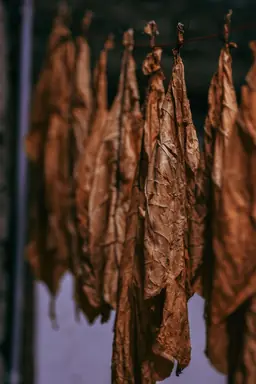
The cure matters as much as the plant. Air-cured leaf, such as Burley, is nutty and low in sugar and is the usual base for English-style snuff. Flue-cured Virginia is bright, light and naturally sweet. Fire-cured leaf, such as dark fired Kentucky, is smoked over hardwood and gives Scotch snuffs and rappees their smoky depth. Rustica, a different and much stronger tobacco plant, is behind many Indian, African and North African snuffs. German schmalzlers traditionally use Mangotes, a dark Brazilian tobacco fermented for a long time in rolls. Most commercial snuffs are blends of several of these.
Leaf or stem
Flour can be milled from the leaf blade (the lamina), from the stems and midribs, or from both. The leaf blade carries most of the plant's nicotine and its oils, so it gives a richer, fuller-flavoured base. Stems make a paler, drier base with less nicotine and a sharper, woodier edge. They were never wasted: they go into some dry snuffs, such as certain Irish toasts and Scotch snuffs, and the old French Côtes de Manoques was made from them. For home snuff, most makers sieve out the hard bits of stem.
Why salt and soda are added
Tobacco flour is naturally slightly acidic. A small amount of an alkaline salt, such as washing soda (sodium carbonate), potash (potassium carbonate) or bicarbonate of soda, raises the pH. That turns more of the nicotine into its free form, which the nose absorbs faster, so the snuff feels stronger and quicker. Plain salt (non-iodised) is added too: it helps the snuff keep, rounds out the flavour and, with water, sets the moisture. This is why too much soda can sting or burn, and why makers keep it to a few grams per hundred.
The main base styles
- Toast: very dry and very fine, roasted or dried hard for a nutty, lightly smoky taste and a quick hit. High Dry Toast and the Irish toasts are the classics.
- Plain or natural: unscented, fine to medium, low to medium moisture, letting the tobacco itself come through.
- SP: medium-fine and medium-moist, lightly scented, usually with bergamot and other citrus oils. Nobody knows for certain what SP stands for. Wilsons of Sharrow links it to "Spanish", after the Spanish snuff captured at Vigo Bay in 1702; others suggest "Sheffield's Pride" or "Special Plain".
- Kendal Brown and rappee: coarse, moist and dark, often fermented, slower and fuller in the nose.
- Schmalzler: German, coarse and moist, made mostly from dark Brazilian tobacco and worked with fat so it clumps softly. The name comes from Schmalz, the lard or clarified butter once used; today paraffin oil is used instead because it doesn't go rancid. A "half-schmalzler" is schmalzler mixed with a menthol snuff.
- American Scotch: extremely fine and dry, often fire-cured and smoky, sweetened in the "sweet" versions.
Snus and other oral snuffs start from tobacco flour too, but they are a different product: far wetter (often around half water), heat-treated and made for the lip, not the nose.
How the big makers do it
In a factory, the cured leaf is first threshed to separate the stems from the leaf blade, re-dried and packed into bales, then aged and fermented, usually for one to three years. A European scientific review sorts tobacco by cure: flue-cured (Virginia), fire-cured (Kentucky), light air-cured (Burley and Maryland), sun-cured (Oriental), and dark air-cured, which it lists as the main tobacco for chewing tobacco, snuff and snus. It also notes that Virginia keeps more of its natural sugar, while Burley's slow air-cure uses its sugars up.
For flour, the leaf is dried, ground and sieved into coarse, medium and fine fractions, which are then mixed back together in set proportions to get the texture each product needs. Patents for Swedish snus give a sense of the scale of the additions: one base is 58 per cent tobacco flour, 33 per cent water, about 6 per cent salt and 3 per cent sodium carbonate, and moister versions run up to around 56 per cent water with glycerol or propylene glycol added to stop them drying out. The heated stage that snus makers call "sweating" is really a pasteurisation, and flavourings go in dissolved in alcohol, most of which evaporates.
The same patents give a handy rule of thumb for moisture: dry snuff is under about 10 per cent water, moist snuff over 40 per cent, and anything in between is semi-dry. Most nasal snuffs sit in the dry to semi-dry range; snus sits firmly in the moist one. Tobacco-free "snuffs" use the same methods with plant fibres, such as maize, oat or buckwheat, in place of tobacco.
Making the flour
Dry the tobacco until it snaps, ideally at a low heat or in a dehydrator, and watch it closely as it scorches quickly. Grind it in short bursts in a grinder kept only for tobacco, then shake it through a fine sieve. A 100-mesh sieve gives a properly fine flour. Grind and sieve what stays behind again, and throw away any hard bits of stem. Leave the fresh flour open to the air for half a day, as it can smell green at first.
Turning flour into a base
A typical English-style base uses 100 g of flour, about 22 ml of cooled boiled water, 3 g of non-iodised salt and 1 to 3 g of washing soda, sometimes with a few grams of bicarbonate of soda as well. Dissolve the salt and soda in the warm water, mix it evenly through the flour, seal the jar and leave it for at least a week before you try it. For a toast, dry-roast the finished base in a pan until it just starts to steam. Scenting comes last: oils, spices or flowers are added to the finished base and left to settle in a sealed jar.
Keep the washing soda low. Experienced makers warn that too much burns the nose; never go above about 3 g per 100 g of flour, and wear gloves when handling it. Our recipes give exact amounts for each style, and Making snuff at home: the basics and Flavouring your own snuff cover the other steps.
Sources
The flour and base methods follow home makers on the Pipe Smokers Den, PipesMagazine and Whole Leaf Tobacco forums, and the community recipe book Snuff, Snus and Chew, edited by Robert C. A. Goff and shared under a Creative Commons licence. The schmalzler details draw on Cigarworld, the Bavarian Economic Archive and Snuffhouse, and the notes on SP on Wilsons of Sharrow and the Sheffield Star. The factory section draws on the European Commission's Scientific Committee on Emerging and Newly Identified Health Risks (SCENIHR, 2010) and on two published patents for Swedish snus manufacture, EP2012601 and US10736350.